HISTORY & HI-LIGHTS
OF THE LION & LAMB LODGE NO. 192
Before I talk about the actual formation and history of our own
Lodge, I wonder if I may set the scene a little both generally
and masonically and, for reasons which will shortly become obvious,
I would like to choose not 1789 but 1786 as a starting date. Think
for a moment of the World as it then was.
Not a very notable year in itself
- indeed not a very memorable decade as a whole. 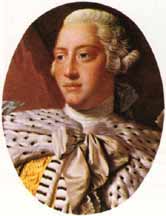 George III was on the throne with William Pitt
as Prime Minister at the very young age of 27. We had just lost
the American War of Independence and, in 3 years time, Washington
was to become the first president of America. We had, for years
off and on, been at War with France although Napoleon was then
Only 17 - Nelson was 28 and, as for Hornblower - he would have
been about 51. In the world of music, Beethoven had barely started
as he was just a youth of 16, but Mozart, at 30, was in full flight.
Literature was doing quite well - Rabbie Burns at 27 was enjoying
himself in Scotland and, although Dr. Johnson had been dead 2
years, Boswell was in the middle of his biography and was 46.
Some had not yet started. Sir Walter Scott was 15, Wordsworth
16 and Jane Austen still a tender babe of 1 year. It was a mid-period
for the great English painters - Gainsborough was past his best
at 59 and Constable, aged 10, had hardly started. We were nearing
the end of the great furniture designers; Chippendale had been
dead for 7 years, Hepplewhite died that year but Sheraton was
in his prime at 35. Very little was happening in the world of
science - Sir Humphrey Davy was only 8 and Faraday was not born
for another 5 years. There was, of course, no electricity nor
gas and no railway system at all. The steam engine had just been
invented by James Watt but George Stephenson was only 5 and hardly
thinking about trains.
George III was on the throne with William Pitt
as Prime Minister at the very young age of 27. We had just lost
the American War of Independence and, in 3 years time, Washington
was to become the first president of America. We had, for years
off and on, been at War with France although Napoleon was then
Only 17 - Nelson was 28 and, as for Hornblower - he would have
been about 51. In the world of music, Beethoven had barely started
as he was just a youth of 16, but Mozart, at 30, was in full flight.
Literature was doing quite well - Rabbie Burns at 27 was enjoying
himself in Scotland and, although Dr. Johnson had been dead 2
years, Boswell was in the middle of his biography and was 46.
Some had not yet started. Sir Walter Scott was 15, Wordsworth
16 and Jane Austen still a tender babe of 1 year. It was a mid-period
for the great English painters - Gainsborough was past his best
at 59 and Constable, aged 10, had hardly started. We were nearing
the end of the great furniture designers; Chippendale had been
dead for 7 years, Hepplewhite died that year but Sheraton was
in his prime at 35. Very little was happening in the world of
science - Sir Humphrey Davy was only 8 and Faraday was not born
for another 5 years. There was, of course, no electricity nor
gas and no railway system at all. The steam engine had just been
invented by James Watt but George Stephenson was only 5 and hardly
thinking about trains.
The most important vehicles
on the roads were stage-coaches which made regular runs between
London and most large towns. Exeter was a 6 day journey, York
was 4, Birmingham took 2 1/2 days and Dover about 2 days with the
passengers dining at Rochester and sleeping at Canterbury. As
for Edinburgh, well that took 10 days in summer and 12 in winter.
However, things were improving as the first Royal Mail Coach started
in 1784 from Bath to London and made the 106 miles journey in
the record time of 16 hours with a change of horses every 7 miles.
In London itself the most elegant form of travel was still the
sedan-chair. London was hardly the size it is now, the population
was about 250, 000 and indeed the population of the whole of England-was
well under 9 million - about the same as London as it now is.
Freemasonry, however, was starting to flourish in England, after
a period of some disfavour, but unhappily Lodges then in existence
Owed allegiance to one or other of two rival Grand Lodges. The
first, known as the Grand Lodge of England, was established in
1717 and published its first printed Book of Constitutions in
1723. However, a group of Irish masons who had settled in London,
claimed that members of the Grand Lodge had made changes in the
ceremonial but that they themselves had remained faithful to the
ancient rules and landmarks of the Order. Accordingly, in 1751,
they established a body which they termed "The Grand Lodge
of England according to the Old Institutions" and gave themselves
the name of "Antients" - the members of the older and
senior Grand Lodge they termed Moderns".
We therefore had a situation
that Lodges were formed under two jurisdictions each of which
accorded them a number on its own roll. I did say earlier that
1786 was not a very notable year in itself but, as far as we are
concerned, a most important event took place. Dispensation was
sought at the end of 1785 from the Antient Grand Lodge, then known
as The Grand Lodge of the Most Antient and Honourable Fraternity
of Free and Accepted Masons", by a Past Master of Atholl
Lodge to make and form a new Lodge of operative masons - i.e.
brethren who were masons by trade or otherwise engaged in the
building business and, in 1786, the Domatic Lodge, then No. 234,
was consecrated at the Ship Tavern, Lincoln's Inn Fields. As,
however, commented, Operative Masons only were to be admitted
and it is recorded that at a meeting of the Lodge on April 24th,
1786, two Brothers who had been proposed as joining members were
rejected because they were not Operative Masons. This arrangement
did not find favour with the existing members as, of necessity,
it restricted their numbers and indeed they were in further difficulties
as several brethren had changed their vocation. Accordingly, at
an Emergency Meeting held on 15th December 1789 the Worshipful
Master proposed obtaining a new Warrant to the Lodge, known as
a Working Warrant to enable Free and Accepted or Speculative Masons
to be members of Domatic Lodge. This was agreed to and the new
Warrant was actually obtained in some 9 days - perhaps an object
lesson in speed to United Grand Lodge.
This second Warrant - indeed,
W.M., our own Warrant displayed to every candidate on his initiation
- is dated 24th December 1789 and bears the names of W.Bro. Sir
Watkin Lewes, Master Elect- W.Bro. Edward Cook, S.W., and W. Bro.
Thomas Abbott, J.W., who were empowered to form and hold a Lodge
of Free and Accepted Masons at the "Sign of the Sun"-,
Lincoln's Inn Fields, to which the Domatic Lodge had recently
moved, on the second Thursday of each month. The new Lodge was
numbered 258 and when inaugurated it had 165 Lodges on the Roll
as companions. The regular Grand Lodge known then as the "Moderns"
had 174 so that together there were, at that time, only 340 Lodges
on the registers of the two Grand Lodges.
The Domatic Lodge therefore
had two separate warrants, an event without parallel in English
Masonry. Thus, the Lodge afterwards known as the Lion & Lamb,
came into existence. Sir Watkin Lewes, the first Worshipful Master,
was a member of the Joiner's Company, Alderman and Sheriff of
the City of London in 1772 and Lord Mayor of London in 1780. He
was a Member of Parliament for the City and appointed Junior Grand
Warden of the Antient Grand Lodge on 2nd December 1789 when it
was resolved by Grand Lodge that his private Lodge be directed
to pass him through the Chair on the morning of St. John's Day
next if he should not have been installed Master of a Lodge before
that date. There is no doubt that one of the principal objects
in starting this Lodge was to enable Sir Watkin Lewes to occupy
the Chair so that he could qualify for Grand Lodge Honours. He
was proclaimed Senior Grand Warden in December 1790, With the
exception of Sir Watkin Lewes, all the Brethren who formed the
Lodge were also members of the Domatic Lodge and yet when they
attended the Domatic Lodge they signed as visitors.
The two separate Warrants were
worked by the Domatic Lodge until 1795 but obviously this failed
to give satisfaction for, at the regular meeting of the Domatic
held on 27th October 1795, the Worshipful Master ordered the Lodge
to be summoned on Friday, October 30th with the object of taking
into consideration the disposal of Lodge No. 258 and in the minutes
of that Emergency Meeting we read - and I quote - "The Worshipful
Master informed the Lodge that he had ordered the Secretary to
summon the Brothers for this evening to take into consideration
the disposal of the Warrant of Lodge No. 258 as, it being found
that members did not meet to support the two Warrants, and that
Lodge No.258 by this reason was become burdensome, it was thought
best to dispose of it as an application had been made by a respectable
Company of gentlemen",
The suggestion was unanimously
adopted and a Committee appointed to have full power to dispose
of the warrant in such a manner "as they think meet for the
good of the Lodge".
On 26th January 1796 it is recorded
that:
"Bro. Wright presented
the Lodge with the sum of One Pound from Bro. Clark of 244 for
having purchased the Warrant No. 258 and afterwards relinquishing
the same, which sum was put to the moneys for decorating the Lodge,
by unanimous consent of the Members present". The matter
is finally disposed of On the 26th April 1796 when the minutes
of the Domatic Lodge tell us that:- "Bro Wright informed
the Lodge that the Committee appointed for the disposal of the
Warrant 258 had disposed of the same, that the Lodge No. 258 was
to be moved to the "Bear and Wheatsheaf" in Lower Thames
Street and that the Secretary should acquaint the Grand Secretary
of the same".
Thus the baby, now the Lion
& Lamb Lodge, was taken away to work out its own future. It
was obviously intended that we should be a Master Masons Lodge
as the early Minutes make no mention of any initiation but refer
solely to Lectures. Dues were collected at each meeting and were
6d (2 1/2- new pence) per meeting. In those days the Master
and Officers were elected each half-year and the first mention
of an annual election was in December 1815.
As you will know, Worshipful
Master, some of the early Minutes read very curiously. For instance,
a joining Brother was required to deposit his Certificate in the
Ark. Prior to 1814 it was the custom for the Lodge to retain a
Member's Certificate and deposit this in the Ark which was, in
fact, a box kept for that purpose. He could only regain his Certificate
when he resigned as a member of the Lodge.
Undoubtedly the social side
of our activities played a very much more prominent part than
it does nowadays. A minute of June 4th 1812 records that it was
proposed and seconded that the members should dine together on
St , John's Day next and any Brother not dining be fined 3/6d
- members to pay 10/6d which included a bottle of wine and that
a Band of Music of seven musicians be engaged to meet the Lodge
at 9 o'clock in the morning and be at the Lodge's service until
12 o'clock at night. Apparently, the arrangements were that the
members - 43 attended - should march in procession, doubtless
in full regalia, to the place appointed for the dinner or banquet.
It was also resolved at this meeting to send Bro. Morgan, an invalid
and distressed Brother, the sum of 10/6d that he might provide
himself with a dinner on that day.
Many meeting places were recorded
in the first few decades of the Lodge's history, indeed between
1789 and 1810, 9 hostelries are recorded and between 1810 and
1825, a further 10.
The circumstances causing us
to leave certain hostelries make very interesting reading. In
1813 we met at an Inn known as the "Hope and Anchor"
Union Street, Blackfriars. However, the Lodge left this hostelry
under rather peculiar circumstances and the actual minute of May
6th 1813 reads:-
"In consequence of the closet wherein were kept the regalia,
jewels etc. (the property of the Lodge) being broken open, Brother
Andrews - presumably the Landlord - was called up to state by
whom and for what purpose it was done but, failing to give the
Brethren a satisfactory account, and his wife having at the same
time come up to the door of the Preparatory Room and behaved in
a most outrageous manner, it was not only deemed advisable to
move the property of the Lodge, but it was also the unanimous
opinion of the Brethren present that they could not, in justice
to themselves nor the Craft in general, meet in the house again".
This resolution was acted upon and the property of the Lodge immediately
removed to the house of Bro. Matthews till a suitable place could
be found where, to use the language of the Minutes - "our
property might be secure and our persons safe from assault".
The Lodge then transferred to the "Hercules Tavern"
in Threadneedle Street but this again proved temporary as it is
recorded that at the meeting of June 1st 1815 the Landlord, Bro.
Hooper, complained that the remuneration for the use of his rooms,
namely two shillings per night, was insufficient to pay the cost
of the candles, etc., and requested some increase to be made.
It was unanimously agreed to advance the amount to six shillings
with which Bro. Hooper expressed himself satisfied. However, this
resolution was rescinded at the next meeting and as, and I quote,
"consequent discomforts" arose the Lodge was transferred
to the "Cock and Magpie", Wilson Street, Finsbury Square.
The next minute of note is for
February 3rd 1814 when the Minutes are headed "Lodge 325
(late 258)". This was as a result of the Union of the two
Grand Lodges (Modern and Antients) on December 27th 1813 when
the Duke of Sussex was installed Grand Master of the United Grand
Lodge of England. Clause VII of the Articles of Union reads "The
representatives of the several Lodges shall sit under their respective
banners according to seniority. The two first Lodges under each
Grand Lodge to draw a lot in the first place for priority and
to which of the two the Lot No.I shall fall, the other to rank
as No.2; and all the others shall fall in alternately, that is
the Lodge which is No.2 of the Fraternity whose lot it shall be
to draw No.I shall rank as No.3 in the United Grand Lodge, and
the No.2 shall rank as No.4, and so on alternately through all
the numbers respectively."
There were 388 Modern Lodges
and 260 of the Antients making 648 in all. This numbering procedure
explains why our Lodge became No.325 thus taking a more favourable
position than the date of the Warrant justified.
A minute which will be of interest
to our D.C., who is also the Preceptor of the Lodge of Instruction,
is dated June 1814 when the Brethren agreed to meet fortnightly
to instruct each other, this is the first reference to a Lodge
of Instruction. About this time it is evident that Petitions for
Relief were becoming too frequent; at every meeting some brother
was applying for relief. In November 1814 it was agreed that only
Brethren of the Lodge, in distress and applying for relief, shall
be considered. Probably as a result of our generosity the Lodge
became heavily in debt and it is recorded that at the end of 1819
they were in debt to the Treasurer for the sum of £20.4s.0d.
but such was the generosity of the Members that they continued
to give relief to Brethren in distress.
However, this deficit was wiped
off by the end of 1823 and a small balance showed in favour of
the Lodge. Even in those days, attendance waxed and waned and
in May 1822 it was agreed owing to the poor attendance of the
members to adjourn until September. Similarly in 1823 and 1824
various meetings were cancelled.
Our next re-numbering took place
in 1832 when the Lodge No. was changed to 227, late 325. No reason
is given in the Minutes but in fact it was due to so many Lodges
ceasing to work that United Grand Lodge ordered a re-numbering
of all Lodges.
Bye-Laws issued in 1839.
November 1835 is significant as the Minutes begin "Lodge
Lion and Lamb 227". This is the first time the name appears
at the head of the Minutes although it was noted in the records
of United Grand Lodge as early as 1816. At the time United Grand
Lodge was allocating new numbers to the Lodges they also asked
Lodges to adopt names in addition to their numbers. Past historians
have commented that the origin of our name has been lost but,
thanks to a considerable amount of research conducted by our own
Bro. Charles MacColl Botly in the 1960s, we can fairly claim to
have solved the mystery and I quote his own explanation -
"Firstly, there is a complete
record of all taverns and other meeting places of the Lodge, and
the name "Lion" or "Lamb" does not appear.
To the Lodge brethren, the "Lion" was self-evident it
is the Lion Rampant of Scotland, one of the emblems on the banner
of the Antient Grand Lodge, which Arms had also been adopted in
their entirety by our Lodge (and appear on our present banner).
But I am indebted to Bro. Newton, Assistant Librarian at Grand
Lodge, for the information that the "Lion" also appeared
on the Armorial Bearings of the Duke of Kent, whilst the "Lamb"
on those of the Duke of Sussex, respectively Grand Masters of
the "Antients" and "Moderns" at the date of
reconciliation. Thus the name "Lion and Lamb" was adopted
by the Lodge at the time of the formation of the United Grand
Lodge, and it symbolises the merging of the "Antients"
represented by the "Lion", with the "Moderns"
represented by the "Lamb" of the Duke of Sussex. There
is also the Old Testament quotation, "The Lion and the Lamb
shall lie down together".
The name was also adopted to
commemorate the very noteworthy participation of the brethren
of the Lodge in the negotiations culminating in the creation of
the United Grand Lodge, as one of our own members took part in
the negotiations. The "Lion" is also a constant reminder
of our roots in the Antient Grand Lodge, the "Atholl Masons".
We can certainly speculate upon the conversations between the
Lodge brethren upon this subject. They already had the Lion, and
the termination of the rivalry between the two Grand Lodges would
doubtless bring to mind the Biblical analogy. They were quite
possibly unaware of the Heraldic coincidence, and the fact that
the "Articles of Union" were signed left to right, i.
e. Lion and Lamb. As human nature, even Masonic, being what it
is, our early brethren would be gratified that, as "Antients"
this title would give them the "edge" over their erstwhile
rivals. It is apparent that this solution for the reason of the
names was not appreciated or known to the later brethren, for
in the design of the Past Master's Jewel in 1866, the Lion is
depicted lying down, in a natural attitude, with the lamb beside
him. The heraldry had gone."
Inevitably, the occasional dispute
arose between members and one such is recorded in the Minutes
for March 1828 which read -
"Received a letter from
Bro. Smith, P.M., stating that being informed of his having offended
at the last meeting Bro. Carter, P. M., he waited upon Bro. Carter
to say that if he had given him any offence he was sorry for it,
and trusted that as a Mason he would forget and forgive, which
he (Bro.Carter) thought proper to refuse. In answer to this, Bro.Carter
said that he had not the least animosity against Bro. Smith but
he could not consistently, as a Mason, accept an apology unless
it was made in open Lodge, in any way Bro. Smith should think
proper. After some further remarks upon the subject Bro. Jackson
proposed that a letter to that effect be sent to Bro.Smith, which
was seconded by Bro. Button and unanimouslycarried."
This matter was again referred
to at the succeeding meeting in April, when it was agreed that
"A copy of the letter sent to Bro. Smith at the preceding
Lodge should be annexed to the Minutes of the Lodge." The
copy does not, however, appear, nor is anything further recorded
of the incident.
1837 was a memorable year for
us as in January, Bro. Rule presented us with the Tracing Boards
of the 1st and 3rd Degrees which are in use to this day, 166 years
later. Bro.Rule was, by trade, a Painter and Grainier and made
the Boards himself. The Tracing Board of the 1st Degree is true
to type but that of the 3rd is of a design of his own - both are
unique.
Keeping to the chronological
sequence of events and whilst I have not yet had an opportunity
of researching all our old property still remaining, it may interest
Brethren to know that the Secretary's jewel - which I am now wearing
- is itself of considerable antiquity. It was engraved on the
back in 1838 with the number 227, that being the number of the
Lodge at that time, although the date of the jewel is considerably
earlier - about 1802 - or even possibly before then. 1840 recorded
a most unusual event. - the initiation of a minor. It seems fairly
obvious that the youth in question was the son of a member but
even so why this departure from the normal regulations should
have occurred we shall never know. Special dispensation had to
be sought and the relevant extract reads - It having been represented
to the Most Worshipful Grand Master that Mr. George Webster Osbaldiston,
a minor of the age of 20 years and 9 months, son of David Webster
Osbaldiston, is desirous, with the consent of his father, to be
initiated into the mysteries of the Craft, and that he is in all
respects a fit and proper person to be received, His Royal Highness
is pleased therefore to grant this Dispensation". Accordingly,
the young man was immediately balloted for and afterwards initiated
into Freemasonry, for which he was charged the sum of 4. 14s.
6d.
Our Lodge has always kept abreast
of the times and following the introduction of the 1d post it
is not surprising that in December 1843 it was agreed that all
letters "off the stones" be posted instead of the Tyler
delivering them. I assume this related to Summons to members.
However, evidently this resolution was not carried out for there
is a similar resolution put and carried during the year 1863.
Perhaps, at this stage, I could
interject a note of general interest regarding one of the difficulties
that researchers have in compiling accurate historical notes,
as the then Secretaries were not punctilious either in attributing
correct dates of initiation to the relevant year or more importantly
being consistent in the spelling of names. Indeed in the excellent
illustrated history of the Lion and Lamb published by Bro. George
Kenning in 1894 he comments that the then secretaries advanced
the maxim that it was "a sign of a poor scholar to spell
a word only one way". In one case the surname of a Brother
did duty for the town in which he resided and the second Christian
name was utilised for his surname.
I have mentioned our 1st and
3rd Degree Tracing Boards as these in fact pre-date that of the
2nd Degree. However, this can hardly be termed as of recent origin
as it was in fact presented to us in 1853 by one of our then members,
Br. Frederick Breitling. This Board was of his own design and
as far as is known it is the only one of its kind in existence
- the most interesting minute recording our appreciation for this
gift reads:- "That the very best thanks of the members of
this Lodge be given to Bro.Frederick William Breitling P.M. &
G. P. for his very handsome offering and able design of a new
Lodge Board in the second Degree. The Brethren cannot allow this
opportunity to escape without complimenting their Brother Breitling
on the zeal he always exercises in forwarding the interests of
Freemasonry and more particularly of this Lodge. The great want
of a good Lodge Board in this Degree has long been felt and we
may now congratulate the Craft that our Brother's labours should
have produced so pleasing a result. It will be a source of great
gratification to this Lodge should the Craft eventually adopt
it. The Members are fully aware of the time, labour, and research
that have been devoted to this subject and feel the greatest confidence
in recommending the production to the Craft generally."
A not so happy event occurred
two years later in 1855 when we were again forced to seek another
meeting place. The landlord of the "George and Vulture"
where we were then meeting being in difficulties, the Lodge furniture
was seized under distraint for rent. The sum of 17. 11s. 0d was
paid by us, under protest, to redeem the Furniture and the next
meeting was held at the Bridge House Hotel, Southwark. The furniture
had evidently been damaged in either seizure or removal, for a
further sum of 17. 0s. 0d. was later paid for repairs. As far
as one can see, no notice was taken of the protest and the money
was never recovered.
Twelve years later in 1863 Grand
Lodge again ordered a re-numbering of all the Lodges and the minutes
of October 1863 are headed "Lion & Lamb Lodge192 (late
227)". Thus the Lodge has been four times numbered - 258
in 1789, 325 in 1814, 227 in 1832 and 192 in 1863.
At this stage, I wonder if I
might depart from a strict chronological sequence and mention
a few fascinating comments made in his reminiscences by Bro. Cohu
regarding our Festive Board. Whilst I cannot set an exact date
to his first observation, which formed part of a general address
to the Lodge in 1909, it seems appropriate now to mention this
and one or two other extracts regarding the situation in the mid-
and subsequently late 19th Century and early 20th Century.
I quote from his reminiscences
verbatim -
"I remember Bro. Jenkins saying that in the old days there
were no dining or banquets (with the exception of an annual feast
which most Lodges indulged in) and that when the Lion and Lamb
Lodge first indulged in a leg of mutton or something of that sort,
one old Member as a protest against such extravagance, would sit
at the table with the others but have only a bottle of Mr. Guiness'
stout and an Abernethy biscuit. In my own early days the soup,
fish, joints and poultry were all placed on the table and the
Worshipful Master and Wardens carved the principal things whilst
others round the table helped the smaller dishes. After a time
the Hotel wanted to adopt the more modern service, that is to
have the carving done by their men at a side table, but our members
would not have it, they said it was like having a plate of meat
at a cook's shop, they liked to see the joints on the table, and
I believe we were the last party at this Hotel who allowed the
alteration.
I remember poor Bro. Legge,
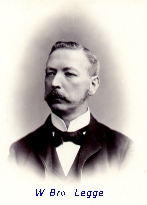 when he was nearing the Junior
Warden's Chair, telling me that the carving would be his greatest
trouble, he could master the work in the Lodge, but he had never
carved a joint or a fowl in his life, as his wife had always done
it. For some years a light wine was put on to begin, then about
the middle of the dinner a limited supply of Champagne. Dinner
being over the cloth was removed, and dessert put on, with decanters
of Port - on the shining mahogany, and Port was the wine until
it was time to go home.
when he was nearing the Junior
Warden's Chair, telling me that the carving would be his greatest
trouble, he could master the work in the Lodge, but he had never
carved a joint or a fowl in his life, as his wife had always done
it. For some years a light wine was put on to begin, then about
the middle of the dinner a limited supply of Champagne. Dinner
being over the cloth was removed, and dessert put on, with decanters
of Port - on the shining mahogany, and Port was the wine until
it was time to go home.
As to harmony in the old days,
we were very happy, without professionals, as such, if one or
two were brought as visitors (masons of course) they would sing
sitting at the table, as our members did, without accompaniment
- but
a good chorus was appreciated! N. B. No Ladies. As we become more
refined, we adopted the present ways, but I have a strong leaning
towards those old days, as more time for conversation was possible,
and we had more facility to make acquaintances.
At one time our numbers were
so few, and our cash so low, the Hotel, through the intercession
of Bro. Abbott, put on a supper for a year or two at 2s. 6d. each,
we had large jugs of ale, and afterwards Whisky, which the majority
took with hot water, lemon and sugar. This was in the next room,
as the party (say 8) was too small for the Pillar Hall. How things
have changed!"
We have always accepted, without
wondering why, that our Installation is in March but in fact it
used to be in January as you will have noticed from the old bye-laws
and the reason for the change is rather interesting. Apparently
in December 1876 a Brother was duly elected to the Chair for installation
in January 1877. However, between December 1876 and January 1877
there was a change of heart by the members as apparently the Worshipful
Master elect had commented that he intended to make many alterations
to the appointment of Officers, including the Secretary. It seems
clear that in those days one did not offend the Secretary lightly
for at the January meeting when the Minutes, including the election
for the Worshipful Master, were put for confirmation, only 9 voted
in favour and 35 against. As a result, the reigning Worshipful
Master remained in Office until March 1877 and the bye-laws were
amended to make March the installation date. Incidentally, I am
happy to say that all was subsequently forgiven and the member
in question did become Worshipful Master a few years later.
However, the contretemps did
not end there for obviously feelings ran high and a member sent
a note of the proceedings to a newspaper called "The Licensed
Victuallers Guardian" who published what is referred to in
the Minutes as a "scurrilous report of the proceedings".
This lead to the unprecedented step of the member who had communicated
to the newspaper being censured in open Lodge and the actual motion
of censure reads - "For sending a distorted report of the
proceedings of the Lodge, reflecting upon the character of several
of its members, to a non-Masonic paper".
Our first experiment at a social
event to bring in our ladies was in 1886 when an annual summer
festival was arranged at, and I quote, "some attractive riverside
place" but obviously this was not a great success as after
two years it was discontinued. However, you will be interested
to learn that our first Ladies' Night was in February 1895 when
special dispensation was granted by Grand Lodge for the Brethren
to dine in Masonic Clothing. Indeed this privilege was obtained
for many years but was discontinued some 45-50 years ago as apparently
some Lodges had brought it into disrepute.
An event occurred in 1886 which
we can now look back on with a smile but which must have caused
acute embarrassment at the time. A Candidate for initiation was
within the Lodge and that stage of the Ceremony had been reached
at which the Senior Warden presents the Candidate to the W. M.
as "a Candidate properly prepared to be made a Freemason".
At this point, the Senior Warden noticed that the Candidate appeared
totally deaf and had not heard a single word of the proceedings
to that time. Being a man of very strong character, he decided
that the Candidate was not properly prepared nor a fit and proper
person and refused to present him. The poor chap was then escorted
from the Lodge, still in a state of darkness in, I imagine, every
sense of the word and that was that. However, the Lodge felt that
they should clarify the matter with Grand Lodge and wrote accordingly.
I think the reply from Grand Lodge is worth quoting -
'Dear Sir and Brother,
I have to acknowledge your letter of the 11th inst. relative to
what occurred at the last meeting of your Lodge respecting a deaf
candidate, and I have consulted with the Grand Registrar thereon
who concurs with me in the
following views:
1st. That blame be attached to the proposer and seconder of the
candidate for not at first mentioning his infirmity to the members
when proposing him.
2nd. That the late S.W. was in error in refusing to present the
candidate on the ground that he was not 'properly prepared' and
a fit and proper person to be made a Mason. The first portion
refers to the arrangement of the clothing and the absence of valuables,
and the second portion to the moral character. Deafness is no
actual disqualification for admission.
3rd. That the Lodge, having gone so far, are now bound to Initiate
the Candidate as best they can, either by means of ear-trumpet
or by a deaf alphabet.
I remain, dear Sir and Brother, Yours fraternally, Shadwell H.Clarke,
G.S."
In fact the seconder of this
Candidate was Bro. Cohu who refers to the matter in his reminiscences
in these words - "A brother asked me to second a Candidate
he wished to propose and I agreed to. He told me that it was his
nephew and that he was rather deaf - I thought that was the case
with many of us and did not realise that it would be impossible
to make him hear. However he went abroad soon after and we never
saw him again. In
consequence of this I have never since seconded a Candidate without
seeing him."
You will obviously expect me
to mention our Centenary in 1889 and certainly I will but I should
perhaps first mention a certain confusion in the date which again
is referred to by Bro. Cohu. Apparently it was thought by the
Brethren that we were constituted in 1769. It seems that in the
Calendar then published by Grand Lodge, the Lodge before ours
No. 191 was dated 1769 - our Lodge had no date as the appropriate
space was left blank and No. 193 was dated 1790. We therefore
assumed hopefully that the space indicated that our date was the
same as the one before, namely 1769, until Grand Lodge pointed
out the factual situation. By all accounts the meeting itself
was memorable although the attendance was perhaps not as great
as one would have desired, there being 25 members and 24 guests.
The then Assistant Grand Secretary attended and in fact the event
was reported at great length in the edition of the magazine "Freemason"
for February 1890. It would take a very long time to read this
report which quoted the various speeches made at the banquet almost
verbatim and I will only observe that its success will certainly
put us on our mettle when we come to arrange our bi-centennial
festival in 8 years time.
One is very much reminded of
the altogether more gracious and leisurely style of living at
the end of the last century when one reads the style of correspondence
in those days. This was drawn to my notice when I read a letter
from Worshipful Brother Henry Muggeridge a Past Master of the
Lodge to the then secretary, Bro. George Abbott expressing his
apologies for non-attendance at the Centenary dinner - if we only
had the time and indeed literary ability to write such letters
nowadays, much to be preferred to dining cards. I will, if I may,
read this letter to you in full -
"My dear Bro. Abbott,
In reply to your kind and complimentary letter I feel very much
obliged to you and the Master of the Lion and Lamb Lodge for the
very flattering invitation you have so kindly sent me, though
I am sorry to say I cannot accept it. The infirmities of advanced
age prevent my doing so, otherwise I should be pleased to be present.
The excitement would be too much. I do not tell you I am ill -
really I am fairly well, but next Saturday will be eight weeks
since I have been out. We are told that the "Ancients"
in their splendid banquets of old, placed a 'Skeleton' at their
festive boards as an 'emblem of mortality', to remind their guests
what was in store for the good people. Now I do not say that I
am or look like a skeleton - on the contrary, as, owing, I suppose,
to the inactive and comfortable life I lead, my weight is between
14 and 15 stones. I imagine that I am somewhat like 'Sancho Panza'
who, when appointed Governor of Barrataria was not permitted by
the Doctor to eat THIS or THAT or drink THIS or THAT - although
he was very desirous of doing so, and so am I, but as discretion
is the better part of valour, prudence says 'don't go', and I
say ditto. Therefore, under these circumstances, I trust you and
Bro. Cohu will kindly excuse me, and now, wishing you all a successful
and pleasant meet, believe me, with fraternal regards to all,
Yours very truly, Henry Muggeridge."
Unfortunately, the closing decades
of the last century saw us passing through a lean period both
in respect of members and funds. On several occasions during the
1880s and 1890s the words - "No Work - No Banquet" appeared
on the Summons and in 1884 we had no initiates or joining members.
The minutes and summons for a few years therefore made rather
sad reading. Funds were so low that both in June and December
1895 we had no banquet or supper and there were similar occurrences
in 1897. However the members rallied round and by the beginning
of this century membership and funds were improving again. The
death of Queen Victoria saw the whole country plunged into a period
of mourning and resulted in the cancellation of the Ladies' Festival
in 1901 and I shall refer to this again in a minute. There were
no matters of startling import during the first few years of this
Century except that following the death of one of our members
in the USA we received a charming but rather unusual letter from
the W. M. of Atlas Lodge No. 316 New York in December 1907 which
makes interesting reading:
"Worshipful Sir and Brethren,
It is with profound regrets that I have to advise you of the death
of one of your members and Past Master of your Lodge, Bro.Thomas
William Fisher. The circumstances of his death were particularly
sad. It seems he had met with misfortune in business at home and
had come to this City with the object of starting life afresh.
He became associated with an institution of which two members
of my Lodge were identified. I am informed that his was a very
loveable character, that he was strictly temperate, and unusually
faithful in the discharge of every duty entrusted to his care.
He was thought a great deal of by everybody with whom he came
in contact. Early last week he was taken ill with pneumonia and
was sent to Bellevue Hospital, this City, where he died on Thursday
last. One of our members secured from the Public Administrator,
his effects, and had them on exhibition at our last communication
on Friday last - his Jewels, apron, certificates, and a History
of your Lodge in which his name is prominently mentioned. This
member, who was associated with the same institution as Bro. Fisher,
brought the matter to the attention of the Lodge officials, and
as his effects consisted of a very small sum of money and a few
personal belongings, it was decided that we take possession of
the Body, have it cared for and buried in our own Plot in Evergreen
cemetery, Brooklyn Borough, New York City. I had the sad pleasure
of officiating at the funeral service yesterday. We debated about
notifying his widow and decided it would be better not to notify
her until after Christmas. There is nothing to be gained by notifying
her at once, and we consider it would be better to have the family
pass the Christmas season without this great grief hanging Over
them. Unfortunately, I have learned today, however, that a former
room-mate of his notified his widow On Friday. I expect to see
this party some time today and get her address, and will then
communicate with her. In the meantime, I presume you will acquaint
the widow with the demise of her husband and inform yourselves
of her circumstances and needs. Our
members are very much interested in this sad case and would be
pleased to hear from you as to just what has been done. In informing
his widow of her bereavement please convey to her and her friends
the utmost sympathy of the Atlas Lodge, and please also obtain
from her wishes as to the disposition of his personal effects.
Yours sincerely and fraternally, Ralph W. Smyth, Master."
Following the death of King
Edward VII in 1910 a very moving resolution appears in the Minutes
for June 2nd 1910 which I think demonstrates the great affection
in which he was held by the whole country - the actual resolution
reads -
"That the Brethren of this
Lodge whilst mourning the lamented death of our late beloved Sovereign
King Edward VII, Patron of our Order, desire to place on record
their high sense of the irreparable loss that the Country and
Craft have sustained by his death, and humbly to give expression
of their feelings of loyal sympathy and condolence to his Majesty
King George V, Her Majesty Queen Mary, Her Majesty the Queen Mother
and to His Royal Highness The Duke of Connaught and Strathearn,
our most Worshipful Grand Master, and the rest of the Royal Family.
Trusting that the thought that their grief is shared by all their
loyal and devoted subjects throughout the world may comfort and
help them to bear the burden of their sudden bereavement."
The next date of historic significance
is November 2nd 1916 when the banner which you see before you
was dedicated. Our old banner dating back to approximately 1809
had become so frail from age that it was impossible
to unfurl it at our meetings. The present banner which has therefore
been in use in the Lodge for 65 years is an exact replica of the
banner of 1809 but with the various numbers of the Lodge added.
It bears the arms of the Antient or Atholl Grand Lodge but with
the old original motto "Kodish Lo Adonia" translated
into English as "Holiness to the Lord". It was dedicated
at our meeting in November 1916 by The Lord Bishop of Barking,
W. Bro.P.G. Chaplain who was then made an honorary member of the
Lodge.
You will no doubt have realised
that at the time of this dedication in 1916 we were roughly at
mid-point in the First World War or, as it was then known, the
Great War. Obviously this proved a difficult period for the Lodge
as so many brethren were serving in different parts of the World
but we were singularly fortunate that we did not have to mourn
the death of any member. In many ways it was an interesting period
as, acting on a suggestion from London Grand Rank Association,
this Lodge together with other London Lodges invited wounded Brethren
from Overseas to our meetings and during this period we welcomed
Brethren from nearly all the Commonwealth or, as the then minutes
note, "from nearly all the Colonies". They were brought
from the different hospitals, entertained by us and returned to
the hospital escorted by various of our own members. We were particularly
fortunate in receiving a number of brethren from New Zealand and
as an expression of gratitude and affection not only did the Grand
Master of New Zealand visit us but we received a most charming
and friendly letter from the President of the New Zealand Expeditionary
Force, Masonic Association, which I am sure you would like to
read -
"Dear Sir and Brother,
We have been desired by the executive of the above Association
to convey to you the feelings of high appreciation entertained
by the members for your kindness to our soldier Freemasons whilst
absent from the Dominion in the service of their King and Country.
The Brethren of the Lion and Lamb Lodge were ever ready to extend
the right hand of fellowship to their Colonial visitors who were
made to feel that they were indeed members of our vast Brotherhood,
and the ties, not only of Empire but of our Ancient Fraternity,
have been drawn closer together in consequence.We hope that at
some future time we may have the opportunity of returning, in
some small measure, the hospitality which your Lodge extended
to the New Zealand Freemasons. Both the Lodge and its members
will ever be held in kindly remembrance by those of our Brethren
who were privileged to be received within its portals, and that
the Great Architect of the Universe may watch over and give you
prosperity will ever be the wish of the New Zealand Freemasons.
With Fraternal greetings to the Worshipful Master, Wardens and
members.
We beg to remain, on behalf of the N. Z. E. F. M. Association,
Yours fraternally,
Geo. Barclay, Lt. -Col. President
A. Hardy, C.F. General Secretary."
The year 1925 was of course
a memorable one for Freemasonry as a whole as it saw the establishment
of the Masonic Million Memorial Fund (which resulted in the building
of Grand Lodge). This Lodge was one of the first to
notify its intention of becoming a Hall Stone Lodge by subscribing
1000 guineas to the fund and received a Certificate to this effect
and subsequently the Hall Stone jewel now worn by The W.M. and
which is passed to each succeeding Master at his installation.
Whilst I am sure we did not celebrate this occasion by dancing
in the streets, it may perhaps have been an expression of our
euphoria that at the end of that year it was decided, for the
first time, to permit dancing at the Ladies' Festival.
Nine years later, 1934, brought
us a further letter of which I am delighted to say the contents
have been recorded for posterity. This was from the Royal Masonic
Hospital and reads -
"Dear Bro. Turner, 10th
October 1934
- The Roll of Founding Lodges -
One page of the Book of Founding Lodges which lies open in the
bronze and crystal casket on the Dedication Stone in the entrance
hall, is turned over every morning with due ceremonial. You might
perhaps like to inform the Brethren at a convenient opportunity
that today the record of the qualification of the Lion and Lamb
Lodge No.192
as one of the original Founding Lodges of the former Freemasons'
Hospital and Nursing Home, was exposed to view.
Yours sincerely and fraternally,
Percy Still, P.G.D.
C.H. Thorp, P.G.D
Our Ladies Festival in 1937
introduced one particularly pleasing note. You will remember that
I mentioned that the Festival in 1901 had to be cancelled following
the death of Queen Victoria which, of course, resulted in the
then W. M., W. Bro. Stokes, missing his opportunity to act as
president. The W. M. in 1937 was unable to attend or preside at
his Ladies night and therefore Bro. Stokes was asked to preside
and enjoyed being president on that occasion more than a quarter
of a century later than would normally have been the case.
1937 also saw one of the greatest
gatherings of Freemasons ever assembled in the World and I refer
to the installation of King George Vlth as Past Grand Master of
the United Grand Lodge of England. This took place at the
Albert Hall in the presence of no less than 10, 000 Freemasons
from all over the world and much mention has been made of the
incredible roar of welcome which greeted the King on his entrance.
We were represented by the S.
W. (in the unavoidable absence of the W. M.) and a number of Past
Masters.
I think that as we are now approaching that period of the Lodge's
history which can be personally recalled by several of our older
members it would be opportune to finish my historic notes at that
point as the events of the last 40-50 years can be recorded in
more detail on another occasion. W. M. and Brethren, despite the
inordinate length of this address I have been able to deal only
cursorily with the history of the Lodge and touch upon only a
few of the high-lights in our long existence. There are many features
omitted - indeed the problem was not to find material but to decide
what to leave out.
I have mentioned briefly, in
the introduction to my talk, various brethren to whom I am indebted
for any information but have had to omit so many other equally
worthy brethren who contributed so much in their time - I
think particularly of Bro. Henry Muggeridge known as the Father
of the Lodge and Bro. Butler 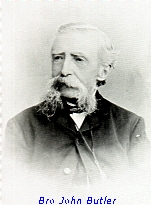 who
achieved the record of 67 years of continuous membership from
1823 till his death in 1890. These and other Brethren may have
been unmentioned but they are certainly not forgotten and will
receive their due acclaim in the history which I have been charged
to write. At one time it was the custom to present an illuminated
address to Brethren who, over a period of many years - sometimes
more than half a century - had given so much of their life to
the well being of the Lion and Lamb.
who
achieved the record of 67 years of continuous membership from
1823 till his death in 1890. These and other Brethren may have
been unmentioned but they are certainly not forgotten and will
receive their due acclaim in the history which I have been charged
to write. At one time it was the custom to present an illuminated
address to Brethren who, over a period of many years - sometimes
more than half a century - had given so much of their life to
the well being of the Lion and Lamb.
Alas we now have little trace
of these addresses - some were handed back to the Lodge but destroyed
with many other irreplaceable items in the last War but, fortunately,
we still have one such address in our possession. This was the
address presented to Bro. Cohu in 1919 to mark his 50 years as
an active member of the Lodge and which recorded his Masonic career
and contained a full list of the then members.
W. M., I do not think I can
better end this document than by quoting the actual words with
which Bro. Cohu terminated his address to the Lodge 72 years ago,
in 1909, and which express so much my own feelings. I quote:-
"l am afraid I
have tired you but when I begin to recall the many happy
hours I have spent at the good old "Lion and Lamb" I
do not know how to
leave off. "
W.Bro John Curtis.